More customers can now make a good espresso without leaving home.
That sounds like a challenge for cafés, and for routine coffee purchases, it can be. A customer with an espresso machine, grinder, and favorite beans may no longer need to stop at a café every morning just to get a cappuccino.
But home espresso is creating another kind of customer at the same time: someone who is more interested in coffee, more curious about how it is made, and more willing to spend money on the category beyond a single prepared drink.
Specialty coffee consumption reflects that growing interest. National Coffee Association survey said that in 2025, 46% of American adults drank specialty coffee in the past day, and specialty coffee drinkers were also more likely to have coffee prepared outside the home than traditional coffee drinkers, 35% compared with 20%. In 2026, specialty coffee consumption increased again to 47% of American adults.
For cafés, the question therefore does not have to be: How do we convince customers not to make coffee at home?
A more useful question is: How can we remain part of their coffee spending even when they do?
Some coffee businesses are already doing exactly that.
The Home Barista Can Still Be a Valuable Café Customer
A customer who buys an espresso machine does not necessarily stop spending on coffee. Their spending can simply move into different areas.
They may want better beans for their machine. They may need help improving their espresso. They may become interested in processing methods or origins. They may want to learn latte art, compare different coffees, or have fresh beans delivered regularly.
That opens additional revenue opportunities for cafés.
Instead of seeing the home machine as the end of the customer relationship, cafés can use their expertise to become part of what happens after someone buys one.
Several coffee businesses already provide useful examples.
1. Press Coffee Turns a $25 Class Into a Subscription Opportunity
Press Coffee Roasters in Arizona runs Coffee 101, a one-hour coffee tasting class held on most Saturdays at its Phoenix roastery.
The ticket costs $25. Guests taste four different coffees and learn how farming, processing, and roasting affect flavor.
But the interesting part is what happens after the tasting.
Every attendee receives a $25 credit toward starting a new Press coffee subscription.
That changes the economics of the class.
curiosity → tasting → preferred coffee → recurring purchase
The customer learns what they like, then receives an immediate reason to continue buying that coffee at home.
The class and subscription are not two unrelated products. One feeds the other. That can naturally lead into a retail bag, subscription, or recurring pickup program.
The important lesson is not simply to start charging for coffee classes. It is to connect the class to the customer’s next coffee purchase.
2. Onyx Coffee Lab Sells Education and Uses It to Support Coffee Discovery
Onyx Coffee Lab has taken coffee education considerably further.
Its public Coffee 101 class has been offered for $25 and combines coffee theory with a guided cupping of several coffees from its catalog. Attendees have also received 15% off their first Onyx subscription order after the class.
Onyx now also operates an education platform with courses for coffee enthusiasts and professionals. Its consumer Enthusiast membership is $19 per month or $149 annually, with access to its course library, live streams, resources, and community. The academy states that it has reached 10,000+ students across its courses.
This is a much broader business model than selling drinks across the bar.
coffee customer → class attendee → student → subscriber → community member.
Expertise itself can become a product.
A café already pays people who understand extraction, milk texture, brewing, and coffee flavor. For the right audience, some of that knowledge can be packaged into experiences customers are willing to pay for.
3. Doe & Fawn Connects Tastings Directly to Retail Sales
Doe & Fawn Coffee Roasters in the UK offers another model that is particularly easy for a smaller café to understand.
Its Cup Tasting & Sensory 101 experience costs £25 per person, lasts approximately one hour, and can accommodate up to 15 people.
Guests taste several coffees, learn about sourcing and coffee flavor, and are then invited to the brew bar and shop with a discount on products after the session.
At the published £25 ticket price, a full 15-person session represents up to £375 in gross ticket sales before any additional retail purchases.
The important part is that the session does not stop at education.
Guests have just spent an hour learning to recognize differences between coffees. They then enter a retail environment where they can purchase the coffees they have become more knowledgeable about.
The business model can be: paid seat + guided tasting + retail offer
And unlike a normal café transaction, the customer may leave with both an experience and a bag of beans they will continue brewing for days afterward.
They are not trying to stop customers from making coffee at home. They are becoming the business that helps customers make better coffee at home.
That is a very different competitive position.
The Café Can Own More Than the Prepared Cup
Consider the difference between these two customers.
Customer A buys a $5 latte from your café.
Customer B buys a $5 latte, attends a tasting, discovers a new origin, buys a bag to take home, and eventually joins a monthly coffee subscription.
The home espresso machine may reduce some of Customer B’s prepared-drink purchases.
But it can also increase their total involvement with specialty coffee.
That is why cafés may benefit from thinking beyond transactions per visit and toward share of the customer’s coffee habit.
You may not make every cup they drink.
You can still roast, sell, teach, recommend, introduce, and supply what goes into many of those cups.
Printed Drinks Can Support Coffee Discovery Too
Printed drinks can have a role here, but only when they contribute to the experience rather than becoming a decoration added for its own sake.
One practical use case is a guided coffee tasting or origin flight.
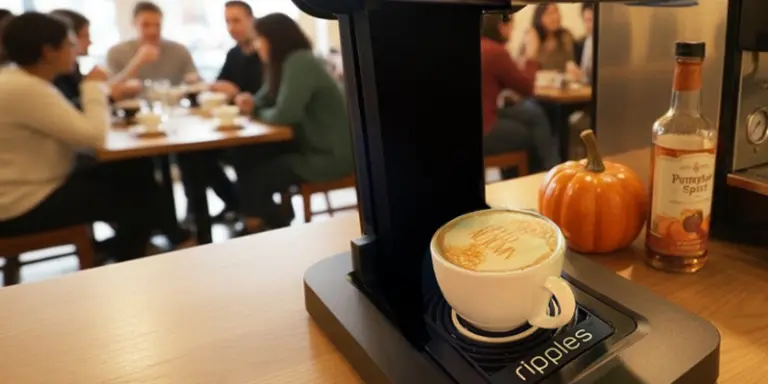
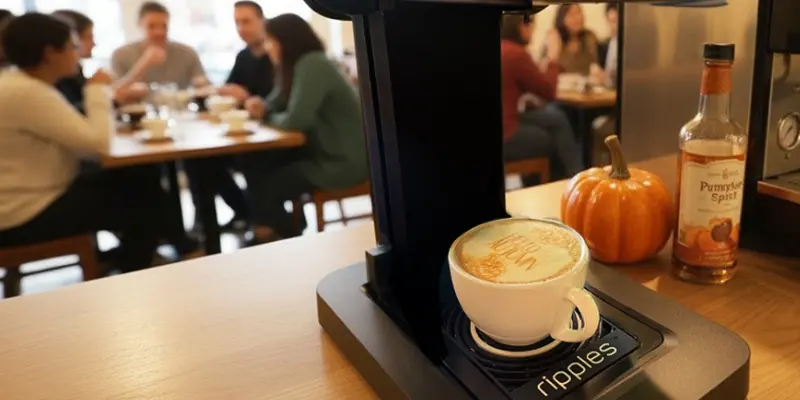
Imagine serving three small foam-topped coffee drinks representing different origins or flavor profiles. Using a Ripple Maker coffee printer, each drink could be printed with its country of origin, processing method, tasting note, or a simple number corresponding to a tasting card.
Instead of the guest trying to remember which cup is Ethiopian and which is Colombian, the information travels with the drink.
A café could use the same approach for:
- Seasonal coffee flights
- New-roast launches
- Subscription-member tastings
- Coffee education nights
- Member or regular recognition
In this context, the print has a job: helping the customer identify, understand, or remember what they are tasting.
That makes it part of the educational experience rather than simply visual presentation.
Takeaway – what you can start doing today
A café does not need to launch classes, subscriptions, retail programs, and tasting flights all at once.
You can start with one measurable test: Run a 10-person Saturday coffee tasting
Charge $20-$30 per person and keep the session to approximately one hour.
Choose three coffees already sold by the café and let guests taste them side by side. Explain the origin, processing method, and major flavor differences. Print it on their coffee foam to make the education easier and more memorable.
At the end, offer attendees a specific next step, such as a discount on one featured retail bag or a credit toward their first subscription order.
Then measure four things:
- Seats sold: Did people pay for the experience?
- Retail conversion: How many attendees bought a bag afterward?
- Subscription conversion: How many started a recurring order?
- Return behavior: How many participants returned to the café within the next 30 days?
The experiment tells you much more than simply whether customers “liked” the tasting.
It tells you whether education can generate additional revenue and strengthen the relationship beyond the café drink.
Conclusion: Don’t Fight the Home Espresso Machine. Become Part of What Goes Into It.
Home espresso changes the role of the café, but it does not necessarily reduce its value.
The customer pulling shots in their kitchen may also be the customer most interested in trying a rare origin, attending a cupping, learning better technique, buying freshly roasted beans, or subscribing to a rotating coffee selection.
The opportunity is therefore bigger than convincing them to leave their machine unused and buy another latte.
Cafés do not need to make every cup. They need to remain part of the customer’s broader coffee habit.
And for an increasingly engaged generation of home coffee drinkers, that habit can extend far beyond the café counter.
Get on the list!
"*" indicates required fields